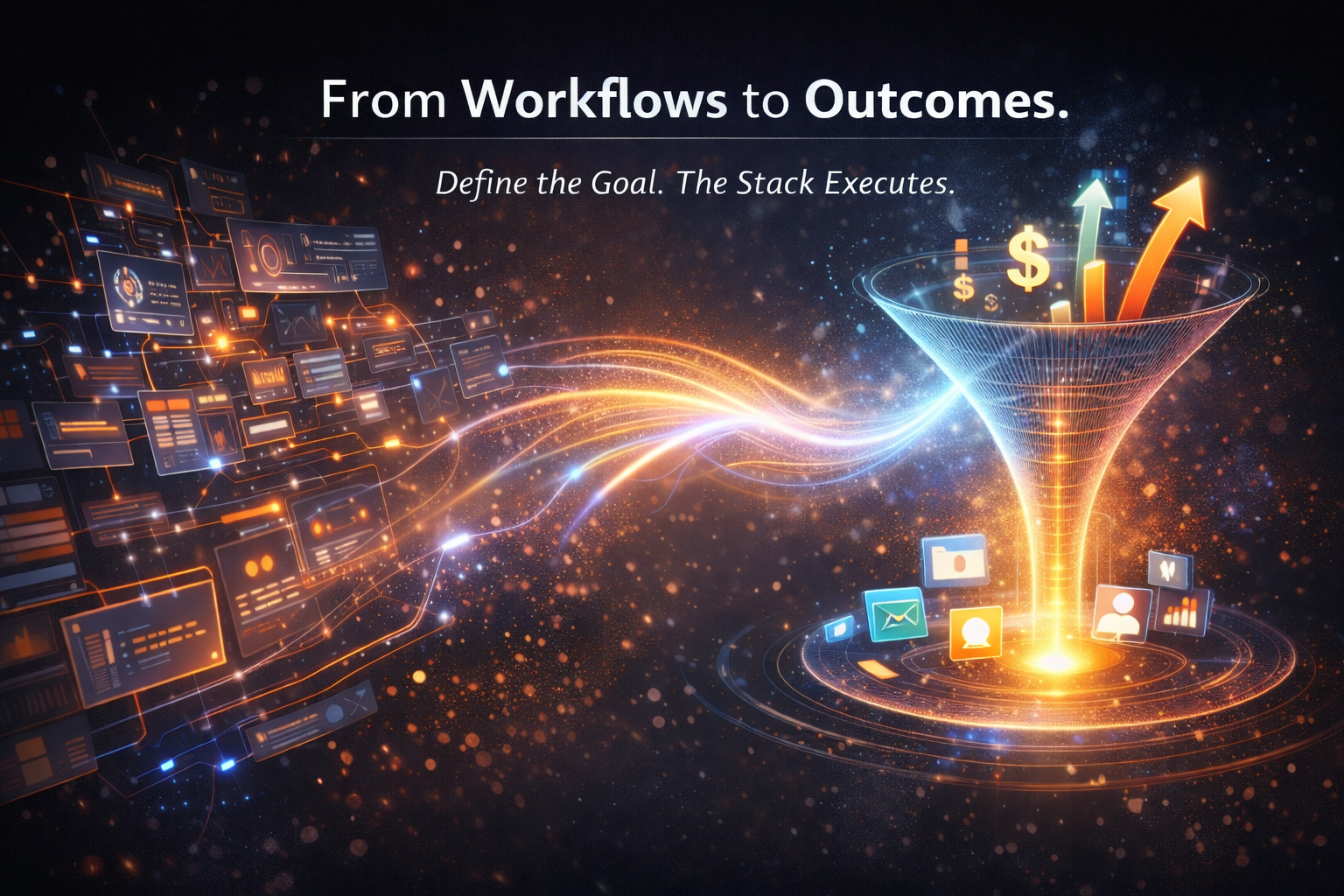
Stop Rebuilding Campaigns. Start Defining Outcomes.
Workflows Were Step One. Agentic AI Is Step Change.
For years, marketing teams have been told the same thing: “Build workflows.”
So we did. We stacked triggers. Layered logic. Connected dozens of tools.
And somewhere along the way, campaign execution became less about strategy… and more about repetitive steps and maintenance.
Today, there is an efficient way to do this. Not because there is a lack of tools, but because we have a pleather of them and they all play their part. Today we hook them all together to perform expected outcomes, accelerate conversion, and demonstrate ROI. We do this for every campaign manually entering each expected outcome. Manually monitoring intent, manually entering a response workflow, manually accessing dashboards to review success and retarget opportunities.
This is where Agentic AI changes everything.
Today’s marketing backend repetitive workflows have entered Agentic AI. This shift is proving extensive ROI for early adopters and the key to slashing campaign launch times from weeks of manual coordination to days of set up and hours of autonomous execution.
From Workflows to Outcomes
Traditional marketing automation is built on:
If-this-then-that logic every time you set up a campaign
Manual orchestration across platforms
Static outcomes
Agentic AI flips that model.
Instead of telling the system how to execute every step, you define:
The goal.
And the system determines:
· What actions to take
· When to take them
· Which channels to use
· How to optimize in real time
This isn’t automation. This is autonomous execution.
What Agentic AI Actually Does in Campaigns
Agentic AI doesn’t replace your tools, it connects and activates them. There is a learning curve, a shift in how you use your tools more efficiently. You now get to strategize, test, adjust, and execute across platforms like:
HubSpot
6sense
Google Analytics
Marketo
Clay
Constant Contact
Bombora
Claude
OpenAI
Canva
…it acts as the orchestrator layer.
For Example: A Webcast Campaign
Instead of manually building:
Invite emails
Reminder sequences
Attendance branches
Follow-ups
You define:
“Launch a 5-part webcast series targeting high-intent accounts.” By a defined Industry, segmentat, ICP.
The agent:
Pulls intent data (6sense, Bombora)
Builds segments (HubSpot, Clay)
Generates emails (Breeze, OpenAI, Claude)
Designs assets (Canva)
Executes campaigns (HubSpot, Marketo)
Tracks performance (Google Analytics)
Optimizes in real time
Reducing your steps and automating the workflow.
The ROI of Agentic Campaigns - This is where it matters.
⏱ Time Savings
Traditional campaign build:
8–20+ hours per campaign
Multiple tools, handoffs, QA cycles
Agentic AI:
60–80% reduction in setup time
Campaigns launched in hours—not weeks
You Build the strategy, Review, Execute
📈 Performance Lift
Because Agentic AI:
Continuously optimizes timing and execution
Adapts based on engagement signals (not manual lists)
Prioritizes high-intent accounts
Teams are seeing:
Higher conversion rates
Better engagement across channels
Faster pipeline velocity
💰 Operational Efficiency
Instead of:
Manual repetitive workflows and activities
Managing more dashboards
You:
Scale campaigns with higher ROI
Reduce tool friction
Eliminate redundant manual work
Where This Shows Up Across Your Stack
Agentic AI thrives in complexity. Here’s how it activates your ecosystem:
🎯 Data + Intent Layer
6sense
Slintel
Bombora
HG Insights
👉 Identifies who to target and when
⚙️ Execution Layer
HubSpot CRM
Salesforce
Marketo
Constant Contact
👉 Launches and manages campaigns
🎨 Content + Creative Layer
Canva
Adobe Creative Suite
Figma
HeyGen
👉 Generates assets at scale
🧠 Intelligence Layer
ChatGPT
Claude
Perplexity
👉 Drives decisions, messaging, and optimization
📊 Analytics + Optimization
Google Analytics
SEMrush
Hotjar
Screaming Frog
👉 Measures and refines performance in real time
What This Means for Marketing Teams
This isn’t about replacing marketers. It’s about changing their role.
Before:
· Build workflows
· Manage tools
· Build Create
· Execute tasks
Now:
· Define strategy
· Set objectives
· Orchestrate outcomes
The Human in the Loop: The Pilot, Not the Passenger
A common fear is that "agentic" means "uncontrolled”. Agentic AI requires better marketing, not less of it.
There is still strategy, ICP definition, messaging, branding, and tone-of-voice training. You need to reason and have good judgement. The difference, however, is you are no longer the one moving the bricks; you are the architect designing the building. You set the guardrails, define the brand's soul, and let the agents handle the repetitiveness that used to take weeks to set up and more labor to optimize.
The future isn't about doing more with less, it’s about doing everything at once. Are you ready to stop manually repeating "if-this-then-that" and start following a goal?
The Shift Is Already Happening
Platforms like HubSpot Breeze are already:
Generating workflows
Recommending actions
Automating execution layers
But this is just the beginning.
The Bottom Line
The future of marketing isn’t:
More tools
Better dashboards
Smarter workflows
It’s:
Systems that execute campaigns for you. You work smarter not harder.
Agentic AI doesn’t just improve how you work. It accelerates entire categories of work.
Final Thought
If your campaign requires:
10+ tools
20+ steps
Multiple dashboards
You don’t have a campaign problem. You have a system problem.
And Agentic AI is the solution.

What Cherie DeVaux’s Kentucky Derby Win Teaches Women About Leadership, Risk, and Going For It
Golden Tempo wasn’t supposed to win.
At 70–1 odds, sitting at the back of the pack with half a mile to go, the story was already written, just not the one that unfolded.
Then everything changed.
Golden Tempo surged from last to first.
And with that finish, Cherie DeVaux became the first female trainer to win the Kentucky Derby.
Let that sink in.
Against the Odds Isn’t a Metaphor It’s Reality
Cherie didn’t just win a race.
She broke through a decades old system!
And what struck me most wasn’t just the win, it was what she said:
“You can dream big, and you can pivot. You can come from one place and make yourself a part of history.”
She started 22 years ago as an exercise rider.
At one point, she was at a crossroads, unsure, questioning, like so many of us have been.
Someone believed in her before she fully believed in herself.
And she chose to go for it.
This One Felt Personal
A lot of women will read this story and feel something deeper.
I know I did.
Over 20 years ago, I started my career in IT, another space where women are often underrepresented.
And while no one says it out loud, you feel it:
The pressure to prove more
The need to move faster
The constant question of “Did I do enough?”
But here’s the truth:
👉 Yes, We show up!
Women Win!
Time and time again, women have shown up, not just to participate, but to lead, to build, to win.
We are:
Leaders in our careers
Leaders in our homes
Navigators of complexity
Masters of resilience
And yet, we still hesitate.
“Am I ready?”
“Is this the right time?”
What If You Don’t Go?
Cherie DeVaux said she never imagined she’d be sitting there as a Derby winner.
Most women don’t imagine themselves there until they are.
The real risk isn’t trying and failing.
👉 The real risk is never stepping into the race at all.
At the Back of the Pack Is Still in the Race
Golden Tempo was last.
Not behind.
Not out.
Just… not leading yet.
There’s a difference.
Representation Matters And So Does Action
Cherie said:
“I’m glad I could be a representative of women everywhere.”
Representation matters.
Seeing someone do it matters.
But what matters more is what we do with it.
👉 Do we watch?
👉 Or do we move?
I am at a Crossroads, and I’m moving!
I’m in a season where I’m being pushed and encouraged to take the next step.
To trust what I’ve built.
To go further.
And like Cherie said, sometimes others see something in us before we fully see it ourselves.
That makes it worth exploring.
Go For It! Even If You’re Not Sure
Here is what I have learned:
There is no perfect timing
You own your destination
You don’t need permission
You need:
👉 Courage to take the Risk
👉 Conviction
👉 And the willingness to try
Final Thought
Golden Tempo didn’t win because the odds were in his favor.
He won because he was in and kept going.
And Cherie DeVaux didn’t make history because it was expected.
She made history because she stepped into the race!
To every person reading this:
You are not behind.
You are not out.
You are in the race.
And you never know—
👉 Your surge might be coming next.
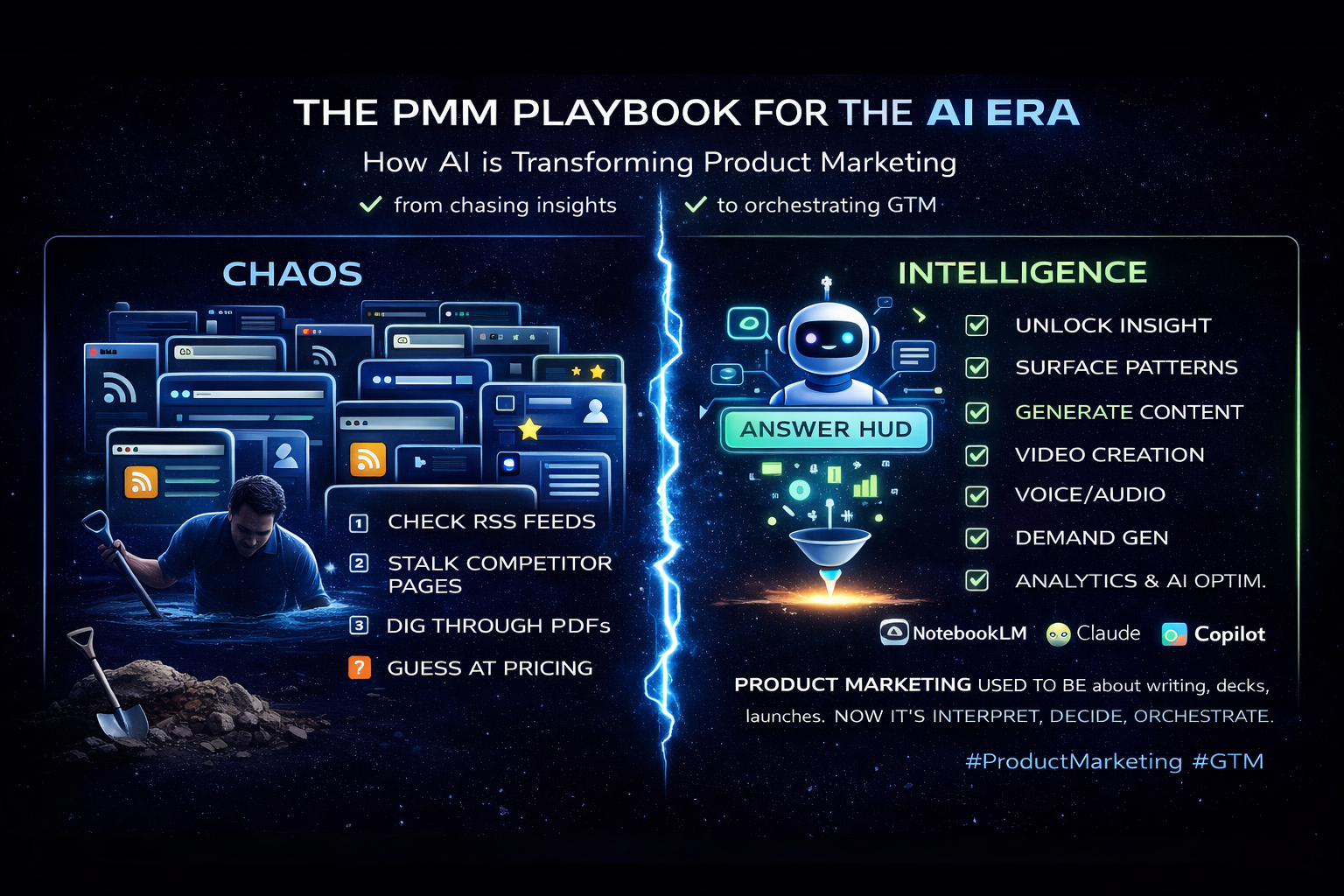
The PMM AI Playbook You Can Actually Use
Now I can analyze my entire market before I finish my first cup of coffee. I have more time to strategize, deep dive into my technology, position, get in front of my customer during their inquiry.
Gone are the days of chasing information, refreshing RSS feeds, 15 tabs open, digging through competitor announcements, hunting for pricing that may or may not be public, and drowning in PDFs, Analyst Reports, and hoping to find one usable insight that I can replicate across 20 different artifacts!
Don’t get me wrong, those skills still matter.
But now? I don’t go looking for answers. I don’t copy and paste, copy and past……
👉 My day starts with a prompt.
AI is redefining what great PMMs do day‑to‑day. Work that used to take months, research, positioning, launch planning, now happens in minutes.
But here’s the important part:
AI didn’t replace Product Marketing. It removed the friction.
What’s left is the real job:
· understanding customers
· making decisions
· orchestrating GTM
This is a practical playbook for that new reality, what to do, which tools to try, and how to turn AI into visible, defensible value as a PMM.
The New PMM Operating Model
For years, PMMs were measured by output: decks, one‑pagers, messaging docs, launch plans. The work was execution‑heavy and often reactive.
AI flipped the script.
· Old PMM → Execution
You personally write every asset and manually pull every insight.
· New PMM → Orchestration
You design the narrative, the systems, and the experiments—then use AI to research, synthesize, and scale.
Your leverage is no longer how fast you can type; it’s how well you can direct your “AI model” toward meaningful outcomes.
1. Insight & Voice‑of‑Customer Intelligence: Leverage raw Customer data
PMMs are surrounded by signals: customer interviews, support tickets, call recordings, community threads, win/loss notes. The problem has never been too little data, it’s that no one had time to read it all.
Turn raw data into positioning and real customer speak.
What to do:
Analyze interviews, tickets, win/loss, calls
Extract patterns, objections, language
Tools:
NotebookLM: ingest internal docs, extract themes
Claude: best for long-form synthesis + structured thinking
Gemini: strong for data + ecosystem integration
👉 These tools are considered among the most powerful AI assistants for research, writing, and analysis
Outcome:
👉 Messaging grounded in real customer truth—not assumptions
2. Messaging & Positioning: Build Systems, Not One‑Offs
AI can draft infinite copy. That’s not the hard part anymore. The hard part is defining a coherent narrative system that everything flows from.
Design narratives, not just copy
What to do:
Define:
positioning pillars
differentiation
proof
Tools:
Claude: best for structured narrative + tone control
Microsoft Copilot: build decks, messaging frameworks
Gemini: iterate variations quickly
Outcome:
👉 Scalable messaging across:
personas
industries
channels
3. Competitive Intelligence: Always On, Never Overwhelming
Traditional competitive analysis is slow and goes stale quickly. In the AI era, the goal is a live radar.
From snapshots → continuous awareness
What to do:
Monitor competitors continuously
Update battlecards dynamically
Tools:
Crayon
Klue
Claude → summarize + interpret
Outcome:
👉 Less time collecting
👉 More time strategizing
4. GTM Planning & Launch Orchestration: From Chaos to Simulation
Launches are where PMMs earn trust or lose it. AI helps you move from “spreadsheets and chaos” to something closer to simulation.
From chaos → simulation
What to do:
Build launch plans
Simulate demand scenarios
Identify gaps early
Tools:
Microsoft Copilot → planning, timelines, decks
Gemini → structured workflows
Claude → scenario modeling
Outcome:
👉 Faster launches
👉 Better alignment
👉 Accelerated Pipeline
5. Sales Enablement: See What Actually Wins
Most PMM enablement is built on gut feel and anecdotes. AI lets you see the patterns across hundreds of calls and opportunities extracting real relevant information to design enablement tools that directly relate to real customer data.
What wins deals
What to do:
Analyze calls + CRM activity
Identify winning messaging
Tools:
Gong
Seismic
Claude
Outcome:
👉 Real-time enablement
👉 Data-backed talk tracks
6. Content & Campaigns: 10× Output Without 10× Headcount
This is the obvious use case, but it’s also the easiest to get wrong.
Use AI for:
First drafts of blogs, landing pages, nurture sequences, and ads.
Repurposing: turn one webinar into a recap article, social posts, outbound sequences, and internal enablement.
Channel‑specific tweaks: same core idea, tuned for email vs. LinkedIn vs. website.
Scale without losing quality
What to do:
Create:
Blogs/white paper/core asset
landing pages
campaigns
Repurpose across formats (Infographic, carousel, multi-channel)
Tools:
Claude: long-form writing
Gemini: fast drafts + variations
Microsoft Copilot: document creation
Adobe Firefly: visuals + brand assets
👉 AI tools now span writing, design, and business workflows, making content creation significantly faster and more scalable
Outcome:
👉 10x content velocity
👉 Consistent brand execution
7. Video Creation & Personalization
Human storytelling at scale, video is king, a moving visual is more interesting than lifeless words on a page all day long!
What to do:
Build:
product explainers
demo videos
personalized outreach
Tools:
Synthesia
HeyGen
Outcome:
👉 High-impact storytelling
👉 Without production bottlenecks
8. Voice, Audio & Globalization
Scale across markets, ICPs, and localization with a few clicks.
What to do:
Create:
voiceovers
podcasts
localized content
Tools:
ElevenLabs
👉 Known for highly realistic speech synthesis and rapid adoption in AI workflows
Outcome:
👉 Faster global expansion
9. Demand Generation & Personalization
Right message. Right account. Right time. Feed the LLM! Your customers are making decisions before they even come to your webpage, knowing, publishing, and amplifying your ICP purchasing patterns, FAQs and inquiry strings will roll you up into LLMs.
What to do:
Build ICPs
Personalize campaigns
Align messaging/FAQs/Inquiries to buying signals
Tools:
6sense
HubSpot
Nanobanana
Outcome:
👉 Higher conversion
👉 Accelerated/Qualified pipeline
10. Analytics, Forecasting & AI Discovery
Measure, optimize, and get served up
What to do:
Track funnel performance
Predict outcomes
Optimize for AI discovery
Tools:
Google Analytics
Tableau
Gemini
Microsoft Copilot
HubSpot/SEMrush LLM Graders
Outcome:
👉 Smarter decisions
👉 Visibility in AI-driven buying journeys
Getting Started: Proving Value and Time‑to‑Impact
All of this is nice in theory. As a PMM, you’re judged on results. A simple way to make AI value visible:
· Pick 1–2 areas as pilots (for example: win/loss analysis and launch planning).
· Document “before” baselines: time spent, asset quality, launch slippage, win‑rate data quality, etc.
· Run your AI‑powered workflow for a quarter.
Report back in the language your execs care about:
· Cycle time: “We cut launch planning from 6 weeks to 3.”
· Coverage: “We analyzed 10× more calls for win/loss without adding headcount.”
· Impact: “Sales is using the new battlecards in 60% of opps; win‑rate against Competitor X is up 5 points.”
You’re not selling “we used AI.” You’re showing we changed outcomes.
The Reality: Power and Risk
The upside is real:
· Massive productivity gains
· Smaller teams, bigger output
· Insight from data you never had time to read
And so are the risks:
· Generic messaging
· “AI sameness”
· Skill gaps
PMMs who never learn to direct AI are getting left behind
The New PMM: Strategy Amplifier
The best PMMs don’t rely on AI.
They direct it.
They:
own the insight
define the POV
make the decisions
And let AI:
summarize
draft
scale
Final Takeaway
AI is not your replacement.
👉 It’s your multiplier.
The future PMM is not:
👉 the fastest writer
The future PMM is:
👉 the best decision-maker
Your New Tools
· Fast.
· Relentless.
· Always on.
And still needs direction.
And that’s where you win.
AI Isn’t Replacing Your Marketing Team, Bad Strategy Is!
There’s a quiet shift happening in marketing organizations right now—and it’s not what most people think.
AI didn’t suddenly make ten-person marketing teams obsolete.
But job descriptions would have you believe it did.
Today, I’m seeing roles posted that expect one person to do the work of:
a demand gen lead
a content strategist
a product marketer
an ABM marketer
a marketing ops specialist
a field marketer
a partner marketer
an events planner
a designer
and a publisher
All wrapped into one.
And here’s the catch:
👉 No requirement for actual AI experience
👉 No mention of agentic workflows
👉 No operational understanding of how AI integrates into execution
Just an assumption:
“AI will make this possible.”
The Fantasy: AI as a Force Multiplier
Yes, AI is a force multiplier.
But only when:
strategy and goals exist
workflows are designed intentionally
tools are integrated properly
teams are trained to use them
and expectations are grounded in reality
AI doesn’t magically replace execution.
It accelerates it, if you know what you’re doing.
What I’m seeing instead is this:
Organizations are reducing headcount first……and figuring out how AI fits later.
That’s not transformation.
That’s cost-cutting with a narrative.
The Reality: AI Requires More Structure, Not Less
The irony is that AI actually increases the need for:
clear processes
defined roles
strong editorial oversight
performance measurement frameworks
Without that, AI doesn’t scale output, it scales disfunction.
You don’t get:
👉 better campaigns
👉 stronger messaging
👉 higher conversion
You get:
👉 more content
👉 more activity
👉 less clarity
And ultimately worse outcomes
The Talent Mismatch No One Is Talking About
Here’s where it breaks down even further.
These “AI-enabled” roles:
expect full-funnel ownership
demand cross-functional execution
require both strategy and hands-on delivery
…but don’t require the one skill set that actually makes it work:
👉 AI workflow design and orchestration
Agentic AI, automation pipelines, content systems, data integration—
this is the real unlock.
And it’s rarely mentioned.
Instead, companies are hiring for:
“10+ years of experience, full-stack marketer, operates across everything”
With 500+ applicants per role.
Why This Matters
This isn’t just a hiring issue.
It’s a signal that many organizations:
don’t yet understand how AI changes marketing
are underestimating the operational lift required
are overestimating what one person can realistically deliver
And in the process, they risk:
burning out top talent
slowing down execution
and missing the very growth they’re trying to accelerate
What High-Performing Teams Are Actually Doing
The teams that are getting this right look very different.
They’re not eliminating roles—they’re redefining them.
They are:
building AI-assisted workflows, hiring the right people
pairing operators with systems, not expecting unicorns
investing in process before scale
measuring output and outcomes, not just activity
They understand:
👉 AI is not a shortcut
👉 It’s an operating system upgrade
The Bottom Line
AI will absolutely reshape marketing organizations.
But not in the way these job descriptions suggest.
It won’t replace five people with one.
It will enable better performance from the right team structure.
The companies that win won’t be the ones that cut the deepest.
They’ll be the ones that:
understand the work
design the system
and build teams that can execute within it
A Final Thought
If your hiring strategy depends on finding one person to do the job of ten….
AI isn’t your solution.
It’s your excuse.
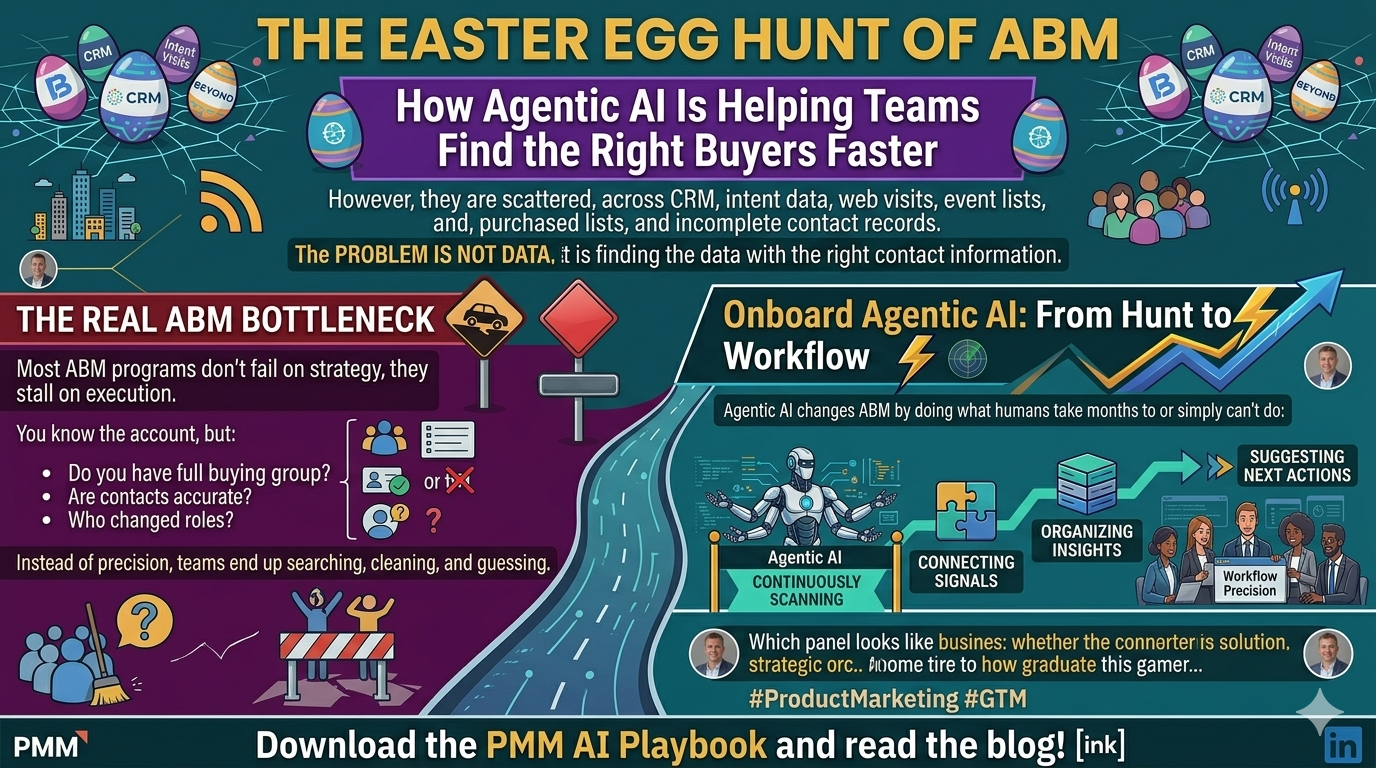
🥚 The Easter Egg Hunt of ABM
THE PMM PLAYBOOK FOR THE AI ERA
Agentic AI Is Helping Teams Find the Right Buyers Faster
Enterprise ABM has always felt like an Easter egg hunt.
o The right accounts are there
o The buying group is there
o The signals are happening
However, they are scattered, across CRM, intent data, web visits, event lists, purchased lists, and incomplete contact records.
The problem is not data. It is finding the data with the right contact information
The Real ABM Bottleneck
Most ABM programs don’t fail on strategy; they stall on execution.
You know the account, but:
· Do you have the full buying group?
· Are contacts accurate?
· Who changed roles?
Instead of precision, teams end up searching, cleaning, and guessing.
Onboard Agentic AI: From Hunt to Workflow
Agentic AI changes ABM by doing what humans take months to or simply can’t do:
· Continuously scanning
· Connecting signals
· Organizing insights
· Suggesting next actions
Less hunting. More engaging.
Where It Drives Immediate Impact
1. Buying Group Discovery
Finds missing stakeholders
Maps personas to roles
Expands coverage across decision-makers
👉 From one lead → full buying committee
2. CRM Hygiene (The Silent Killer)
Flags duplicates, stale data, missing fields
Continuously cleans, not quarterly panic
Limits additional licensing fees
👉 Better targeting = better outcomes
3. Signal Unification
Brings together:
Web activity
Intent data
Campaign engagement
Sales interactions
Event lists
👉 One view of who is in-market
What Improves
Prioritization: focus on accounts that matter
Speed: faster research, faster execution
Personalization: better data = better messaging
Alignment: Sales + marketing operate from the same data points
The hunt becomes precision.
Where Teams Get It Wrong
Agentic AI is powerful, It certainly is not plug-and-play.
Garbage data = faster bad decisions
Over-automation kills nuance
Generic prompts = generic messaging
Buying committees are still human
👉 AI accelerates while humans decide
The New ABM Model
Not autonomous. Not manual.
Human-led. Agent-assisted.
AI finds and organizes the signals
Humans define strategy, narrative, and judgment
A Simple Where to Start (Practical Playbook)
Don’t boil the ocean. Start with one workflow:
Contact discovery
CRM cleanup
Buying group mapping
Account research briefs
Measure:
Time saved
Data quality
Account coverage
Pipeline impact
👉 If it improves one of those—you have a real use case.
🛠️ A Simple Starter Stack
Clay: contact discovery & enrichment
6sense / Demandbase: account intelligence
Insycle / Clearbit: CRM hygiene
Crayon / Klue: competitive insights
Claude / AI assistants: synthesis & drafting
Highspot / Seismic: enablement
Final Thought
ABM was never about finding more data.
It was about finding the right signal at the right time.
Agentic AI doesn’t replace the marketer! It makes the marketer efficient and removes the friction.
Focus on what increases revenue:
Understanding the account
Engaging the buying group
Moving with HUMAN precision
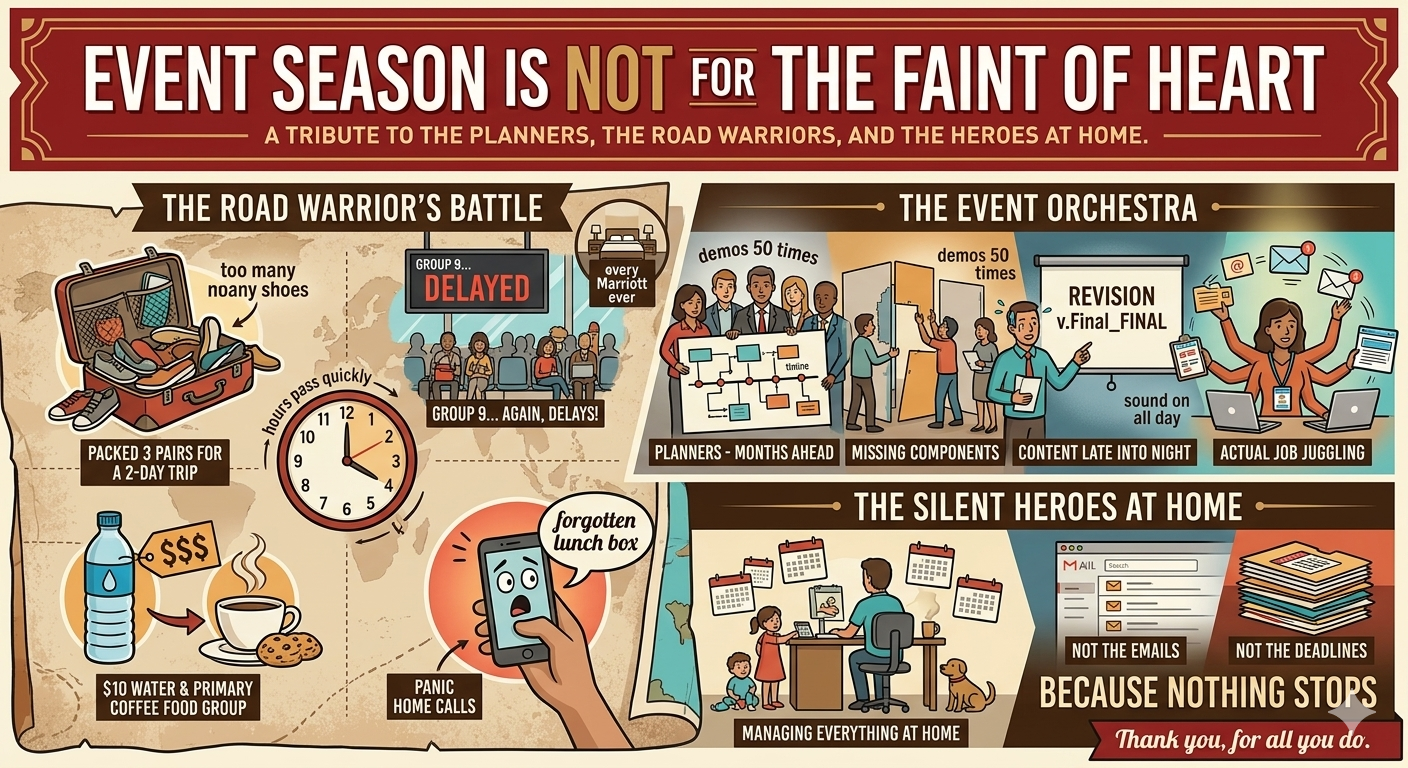
Event Season Is Not for the Faint of Heart
And here we are, heavy into event season! Looks exciting from the outside…
The booths. The keynotes. The energy. The connections.
But if you’ve been in it, you know. Double, triple duty—for all!
Here is a shout out to those who organize, support all sides—in the office, outside the office, and at the home office. You all know:
It’s:
✈️ early flights + delays, boarding group 9… again, and the herculean expectations… you want me to check what and get it where? by myself?
🏨 hotel rooms that all look the same (was I just in this one… or is this every Marriott ever?)
💧 $10 bottles of water that suddenly feel like a luxury purchase, and coffee that somehow becomes your primary food group
☕ breakfasts with strangers (that sometimes turn into great conversations)
📞 panic phone calls regarding a forgotten lunch box, homework, missing dog… did you take the car keys?
And then there’s the organization that looks like wedding planning on steroids:
👉 the planners coordinating months in advance
👉 the teams building booths—and the almost always missing components
👉 the teams running demos, answering the same question 50 times… and somehow still sounding like it’s the first while staying “on” all day
👉 the presenters refining content late into the night, only to change it again five minutes before going on stage—and somehow an old version still gets presented
👉 the constant juggling of your actual job while you’re on the road
Because nothing stops.
Not the emails.
Not the deadlines.
Not the business.
And then there’s the part we don’t talk about enough…
The ones at home… managing everything—and probably wondering why we packed three pairs of shoes for a two-day trip
The ones:
keeping everything running
holding down schedules
making sure life stays on track
While we’re out there doing our thing.
That’s double duty—and it matters more than we say.
So here’s to everyone making event season happen:
👏 the planners
👏 the organizers
👏 the teams on the ground
👏 the presenters
👏 the behind-the-scenes operators
👏 and the people at home supporting it all
It takes all of it—teamwork, resilience… a village, and more coffee than we’d like to admit.
Safe travels to all—and thank you to those who make it possible.
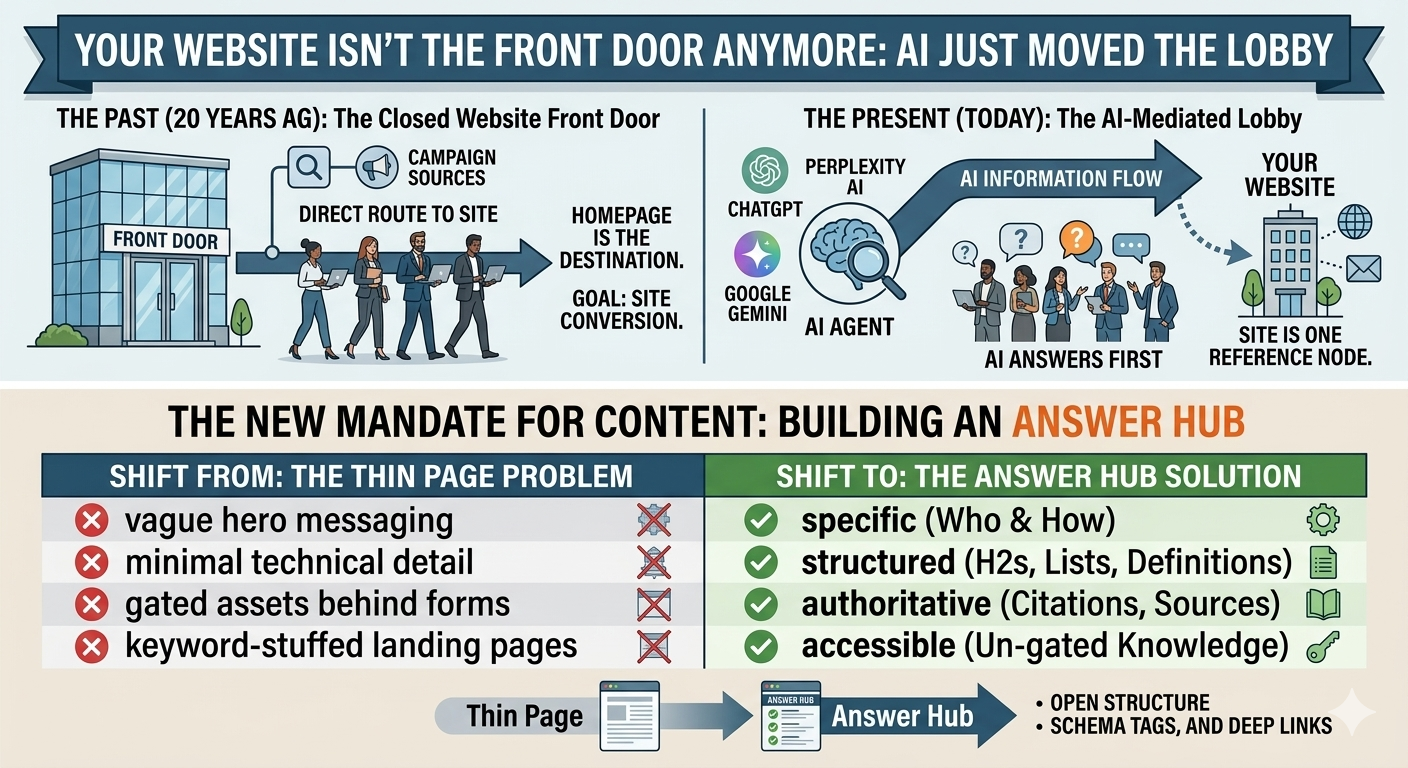
Your Website Isn’t the Front Door Anymore
AI Just Moved the Lobby
For more than twenty years, the website was the center of gravity. The homepage was the front door of buyers’ discoveries. Traffic came from search, social, and campaigns, and the goal was simple:
Get people to land on your page and convert.
But something fundamental has changed. Large Language Models (LLMs) have quietly moved the lobby.
Today, buyers often ask AI systems questions before they ever visit your website. By the time they arrive at your page, much of their research and their vendor shortlist has been formed by what AI systems told them. Your website is still important. But it’s no longer the beginning of the journey. It’s a reference source inside a much larger knowledge ecosystem.
What Has Changed in Buyer Discovery
When buyers research solutions today, they increasingly start with AI tools such as:
ChatGPT
Perplexity AI
Google Gemini
Instead of clicking through ten search results, buyers ask direct questions like:
“What are the best hybrid cloud managed service providers?”
“What is the difference between mainframe modernization and cloud migration?”
“What companies specialize in data platform modernization?”
These AI systems synthesize answers using information from across the web.
Your website is ONLY one source among many.
Which means discovery has shifted from website navigation to AI-mediated knowledge retrieval. Read that again!
What LLMs Are Actually Scraping
When an AI system generates an answer, it doesn’t just read your homepage.
It looks across the entire digital ecosystem for corroborating information.
Typical sources include:
Your owned content
product documentation
technical explainers
blog posts and guides
FAQs and knowledge bases
External validation sources
analyst reports
industry publications
research papers
podcasts and webinar transcripts
Market proof signals
review platforms
comparison sites
partner blogs
developer forums
Community discussions
GitHub issues
Reddit threads
Stack Overflow
LinkedIn discussions
In other words:
Your website is no longer the destination.
It is one node in a knowledge network that AI systems analyze to produce answers.
The “Thin Page” Problem
Many marketing pages were built for search engines rather than knowledge extraction.
They include:
vague hero messaging
minimal technical detail
gated assets behind forms
keyword-stuffed landing pages
These pages were designed to capture traffic.
But LLMs are not looking for marketing slogans. They are looking for answers.
AI systems prefer content that is:
Specific
Who is the solution for? What problem does it solve?
Structured
Clear headings, lists, definitions, and logical sections.
Authoritative
Consistent claims supported by citations and external sources.
Thin landing pages built only for conversion rarely contain enough information for AI systems to reference or summarize.
The New Role of the Website
The modern website must now serve two audiences simultaneously:
Human buyers
AI systems summarizing your expertise
That means marketing pages must function as answer hubs, not just conversion funnels.
Effective pages now include:
clear problem definitions
precise explanations of how solutions work
natural-language FAQs
examples and use cases
links to deeper documentation
comparison tables
implementation guidance
If an AI system lifted two paragraphs from your page, would the reader understand your value proposition?
That is the new benchmark.
How to Be Seen by AI Systems
Organizations that want to appear in AI answers need to optimize content for extractability, authority, and corroboration.
1. Structure Content for Extraction
AI models work best with structured information.
Use:
descriptive H1/H2 headings
short paragraphs
bullet lists
step-by-step explanations
This makes it easier for AI systems to quote or summarize content.
2. Target Real Questions
Traditional keyword research is no longer enough.
Instead, analyze:
customer support tickets
community forums
industry Q&A
“People Also Ask” search results
Turn these into question-based headings and FAQ sections.
3. Provide Clear Answers First
Each section should start with a concise explanation.
Example structure:
Definition → context → example → additional nuance.
AI systems often quote the first clear answer they encounter.
4. Implement Structured Data
Schema markup helps search engines and AI tools interpret content.
Common schema types include:
FAQ Page
How-To Page
Article
Product
Organization
This structured metadata improves machine readability.
5. Demonstrate Authority (E-E-A-T)
Search and AI systems prioritize sources that show:
Þ Experience
Þ Expertise
Þ Authority
Þ Trust
Ways to strengthen these signals include:
author bios
case studies
customer examples
citations to reputable sources
6. Build Topic Clusters
Instead of isolated pages, create topic ecosystems.
Example structure:
Þ Pillar Page
Þ Supporting articles
Þ Use cases
Þ Industry applications
Þ FAQs
Internal linking reinforces topical authority.
7. Publish AI-Friendly Knowledge Formats
Some companies now create simplified content views designed for machine ingestion.
Examples include:
Markdown documentation
technical knowledge hubs
AI-friendly sitemap files such as /llms.txt
These versions remove visual clutter and provide structured knowledge directly to AI systems.
Why External Data Sources Matter
Appearing in AI answers requires more than optimizing your website.
Models look for corroboration across multiple domains.
That means your expertise must appear in:
industry publications
analyst research
partner blogs
research papers
customer reviews
community discussions
conference talks, webcasts, and podcasts
When your message appears consistently across trusted sources, AI systems treat your perspective as more credible.
In other words:
Authority is now distributed across the internet, not confined to your website.
The AI-First Action Plan: From Traffic to Knowledge
Audit for "Answer Hubs"
Turn thin pages into definitive resources. Use clear problem statements, natural language FAQs, comparisons, and implementation guides to ensure you are the source of truth for your category.
Kill the Gate
If it’s gated, it’s invisible. LLMs cannot fill out forms. By hiding your best insights behind a lead-gen wall, you are choosing a handful of emails over being the primary recommendation in an AI’s answer.
Deploy /llms.txt
Create a "fast lane" for crawlers. A dedicated Markdown sitemap provides a clean, "no-noise" version of your value prop that AI agents can ingest in milliseconds without getting lost in HTML bloat. Even just your pillar pages would benefit.
Format for Machines
Structure is authority. Use descriptive H2s, Schema markup, and tight lists. If an AI lifted just two paragraphs from your site, the reader should have everything they need to make a confident decision.
Expand Web Authority
AI looks for consensus. Encourage third-party reviews, industry mentions, and community threads. The more sources that echo your value, the higher the "trust score" the LLM assigns you.
Monitor AI Citations
Track your "Share of Model." Shift your KPIs from "Clicks" to "Citations." Use tools to track where and how AI systems are referencing your brand to find (and fill) knowledge gaps.
If you want your brand to survive and show up in the "moved lobby," you need to stop hoarding information and start distributing it in formats machines take into consideration when serving up your buyers inquiries.
The New Marketing Mandate
Your website hasn’t disappeared.
It has evolved.
Instead of acting as the front door of discovery, it now serves as the reference library that powers AI answers.
Marketing is no longer just about attracting visitors.
It is about ensuring your knowledge appears wherever buyers are asking questions. It always has, the who is the same, the where and how has changed. Because the lobby has moved. And it now lives inside AI.
Now go be the answer in the LLMs your buyer is researching in.
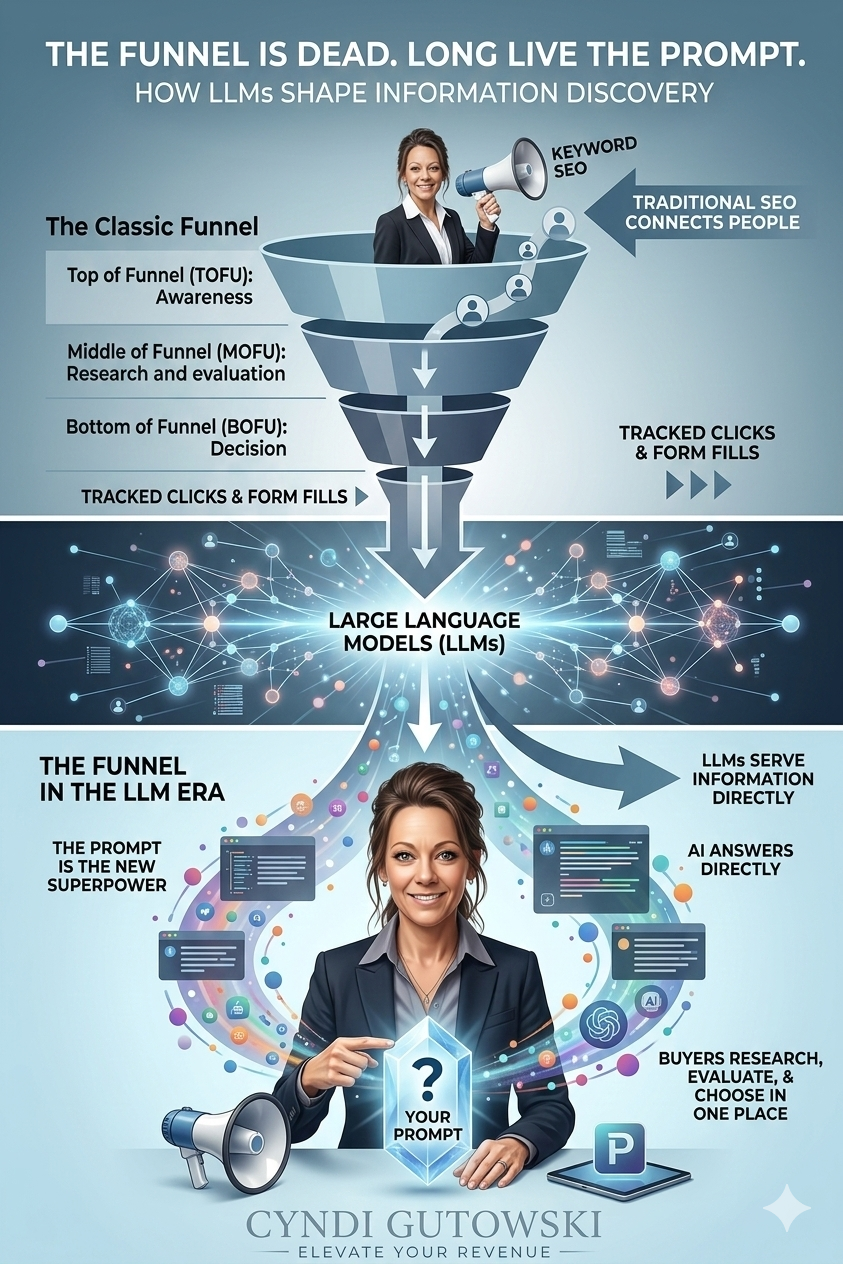
The Funnel Is Dead. Long Live The Prompt.
The Funnel is Dead. Long Live the Prompt
Over a decade of working in SEO and digital marketing, I’ve watched the search landscape evolve through several eras.
The early 2010s marked a pivotal shift in how businesses and buyers engaged online. Social platforms rapidly scaled, Facebook surpassed 500 million users, while LinkedIn emerged as the dominant B2B networking platform. At the same time, the mobile revolution reshaped how people accessed information. By 2020, digital marketing had evolved into a highly sophisticated, data-driven discipline powered by marketing automation, account-based marketing (ABM), analytics, and intent signals giving marketers remarkable visibility into buyer behavior and control over the funnel. But another shift is now underway. As AI and large language models reshape how information is discovered, evaluated, and delivered, the traditional marketing funnel is being rewritten once again.
In the early days of SEO Google search results was a marketer’s superpower. If you understood keywords and content structure, you could dial up visibility, drive traffic to landing pages, and convert search into revenue.
Fast forward to today, and the landscape has shifted again, dramatically.
Search no longer simply sends buyers to information. Now, information comes directly to the buyer. That shift is powered by Large Language Models (LLMs). Traditional SEO connects people to information. LLMs serve the information directly.
SEO is still important, but a new force has arrived, and it is fundamentally reshaping how buyers research, evaluate, and choose solutions.
And in doing so, it has flipped the marketing funnel upside down.
The Funnel We Grew Up With
For decades, marketers operated within a fairly predictable structure.
The classic funnel:
Þ Top of Funnel (TOFU): Awareness
Þ Middle of Funnel (MOFU): Research and evaluation
Þ Bottom of Funnel (BOFU): Decision
With the right combination of targeting, keywords, landing pages, and budget, marketers controlled the awareness path.
· We tracked every click.
· Every form fill.
· Every email open.
Lead scoring systems told us where buyers were in their decision journey. We nurtured them with content, emails, demos, and offers until they raised their hands.
And for many years, that system worked.
But it relied on one critical assumption:
Þ Buyers came to us early in their journey.
That assumption is no longer true.
The Funnel Has Flipped
Today’s buyers often begin with a prompt, not a search query.
Instead of scrolling through ten blue links, they receive a curated answer, often including summaries, comparisons, reviews, and product recommendations.
In a single interface, they can:
· Compare vendors
· Review capabilities
· Read third-party opinions
· Evaluate trade-offs
· Explore communities and documentation
Many buyers now complete 70–80% of their decision journey before ever visiting a vendor website.
The “middle” of the funnel, research and comparison, has effectively moved outside your website into AI interfaces and third-party sources.
It’s invisible. And often much shorter.
Asking an LLM today is like test driving a car before ever stepping on the dealership lot. Buyers can evaluate comfort, performance, and features without a salesperson in sight.
By the time they arrive at your website, they may already know exactly what they want.
Do Funnels and Lead Scoring Still Matter?
So, the natural question becomes:
Is the funnel dead?
Not exactly.
The buyers still exist, of course, but the experience is nonlinear and buyer-controlled.
Discovery and shortlisting now happen through:
· LLM prompts
· Community discussions
· Comparison sites
· Reviews and peer recommendations
Marketing often enters the process much later than before.
Lead scoring also still matters, but traditional models miss most of the high-value journey.
Page visits, form fills, and email opens no longer tell the full story.
Today’s meaningful signals look more like:
· Product trials
· High-intent content engagement
· Community participation
· Peer validation
· Direct outreach
Buyers are increasingly self-directed decision makers.
Research consistently shows that most buyers prefer to conduct the majority of research independently, and many have a preferred vendor before speaking with a salesperson.
In reality, buyers are deciding on their own.
They’re just using everyone else’s data about you to do it.
We Didn’t Lose the Funnel
We changed our monopoly on the information that powered it.
For years, companies controlled the narrative.
Your website.
Your content.
Your lead forms.
Your funnel.
Today, that information is distributed across the internet, and LLMs aggregate it instantly.
But that doesn’t mean marketers are powerless.
It simply means our job has changed.
The New Job of Marketing: Feed the Bots
In an AI-first discovery environment, the brands that win will be the ones that make their information easiest to understand, verify, and surface.
Here are five emerging rules.
1. Make Your Content Easy for LLMs to Understand
Structure information clearly across documentation, FAQs, and product pages so both humans and machines can interpret it easily and accurately. And publish your Mark Downs for LLMs!
2. Publish the Details Buyers Actually Want
Transparency now accelerates decisions. Share implementation guidance, comparisons, pricing context, and even who your product is not designed for.
3. Write for Humans and Machines
Clear headings, structured explanations, and balanced perspectives help LLMs surface accurate answers.
4. Invest in Authority, Not Just Promotion
LLMs trust signals beyond your website. Reviews, Analyst mentions, industry pubs, case studies, and user-generated validation increasingly carry more weight than polished marketing campaigns.
5. Measure What Actually Correlates to Revenue
Focus less on top-of-funnel vanity metrics and more on signals like product usage, trial engagement, and high-intent inquiries.
The New Marketing Superpower
Twenty years ago, keywords were the superpower.
Today, transparency is.
In an LLM-first world, the brands that win will not be the ones guarding their best information.
They will be the ones who explain their value so clearly, and publish it so openly, that both buyers and bots can't help but choose them.
The Funnel is Dead. Long Live the Prompt!
Over a decade of working in SEO and digital marketing, I’ve watched the search landscape evolve through several eras.
The early 2010s marked a pivotal shift in how businesses and buyers engaged online. Social platforms rapidly scaled, Facebook surpassed 500 million users, while LinkedIn emerged as the dominant B2B networking platform. At the same time, the mobile revolution reshaped how people accessed information. By 2020, digital marketing had evolved into a highly sophisticated, data-driven discipline powered by marketing automation, account-based marketing (ABM), analytics, and intent signals giving marketers remarkable visibility into buyer behavior and control over the funnel. But another shift is now underway. As AI and large language models reshape how information is discovered, evaluated, and delivered, the traditional marketing funnel is being rewritten once again.
In the early days of SEO Google search results was a marketer’s superpower. If you understood keywords and content structure, you could dial up visibility, drive traffic to landing pages, and convert search into revenue.
Fast forward to today, and the landscape has shifted again, dramatically.
Search no longer simply sends buyers to information. Now, information comes directly to the buyer. That shift is powered by Large Language Models (LLMs). Traditional SEO connects people to information. LLMs serve the information directly.
SEO is still important, but a new force has arrived, and it is fundamentally reshaping how buyers research, evaluate, and choose solutions.
And in doing so, it has flipped the marketing funnel upside down.
The Funnel We Grew Up With
For decades, marketers operated within a fairly predictable structure.
The classic funnel:
Þ Top of Funnel (TOFU): Awareness
Þ Middle of Funnel (MOFU): Research and evaluation
Þ Bottom of Funnel (BOFU): Decision
With the right combination of targeting, keywords, landing pages, and budget, marketers controlled the awareness path.
· We tracked every click.
· Every form fill.
· Every email open.
Lead scoring systems told us where buyers were in their decision journey. We nurtured them with content, emails, demos, and offers until they raised their hands.
And for many years, that system worked.
But it relied on one critical assumption:
Þ Buyers came to us early in their journey.
That assumption is no longer true.
The Funnel Has Flipped
Today’s buyers often begin with a prompt, not a search query.
Instead of scrolling through ten blue links, they receive a curated answer, often including summaries, comparisons, reviews, and product recommendations.
In a single interface, they can:
· Compare vendors
· Review capabilities
· Read third-party opinions
· Evaluate trade-offs
· Explore communities and documentation
Many buyers now complete 70–80% of their decision journey before ever visiting a vendor website.
The “middle” of the funnel, research and comparison, has effectively moved outside your website into AI interfaces and third-party sources.
It’s invisible. And often much shorter.
Asking an LLM today is like test driving a car before ever stepping on the dealership lot. Buyers can evaluate comfort, performance, and features without a salesperson in sight.
By the time they arrive at your website, they may already know exactly what they want.
Do Funnels and Lead Scoring Still Matter?
So, the natural question becomes:
Is the funnel dead?
Not exactly.
The buyers still exist, of course, but the experience is nonlinear and buyer-controlled.
Discovery and shortlisting now happen through:
· LLM prompts
· Community discussions
· Comparison sites
· Reviews and peer recommendations
Marketing often enters the process much later than before.
Lead scoring also still matters, but traditional models miss most of the high-value journey.
Page visits, form fills, and email opens no longer tell the full story.
Today’s meaningful signals look more like:
· Product trials
· High-intent content engagement
· Community participation
· Peer validation
· Direct outreach
Buyers are increasingly self-directed decision makers.
Research consistently shows that most buyers prefer to conduct the majority of research independently, and many have a preferred vendor before speaking with a salesperson.
In reality, buyers are deciding on their own.
They’re just using everyone else’s data about you to do it.
We Didn’t Lose the Funnel
We changed our monopoly on the information that powered it.
For years, companies controlled the narrative.
Your website.
Your content.
Your lead forms.
Your funnel.
Today, that information is distributed across the internet, and LLMs aggregate it instantly.
But that doesn’t mean marketers are powerless.
It simply means our job has changed.
The New Job of Marketing: Feed the Bots
In an AI-first discovery environment, the brands that win will be the ones that make their information easiest to understand, verify, and surface.
Here are five emerging rules.
1. Make Your Content Easy for LLMs to Understand
Structure information clearly across documentation, FAQs, and product pages so both humans and machines can interpret it easily and accurately. And publish your Mark Downs for LLMs!
2. Publish the Details Buyers Actually Want
Transparency now accelerates decisions. Share implementation guidance, comparisons, pricing context, and even who your product is not designed for.
3. Write for Humans and Machines
Clear headings, structured explanations, and balanced perspectives help LLMs surface accurate answers.
4. Invest in Authority, Not Just Promotion
LLMs trust signals beyond your website. Reviews, Analyst mentions, industry pubs, case studies, and user-generated validation increasingly carry more weight than polished marketing campaigns.
5. Measure What Actually Correlates to Revenue
Focus less on top-of-funnel vanity metrics and more on signals like product usage, trial engagement, and high-intent inquiries.
The New Marketing Superpower
Twenty years ago, keywords were the superpower.
Today, transparency is.
In an LLM-first world, the brands that win will not be the ones guarding their best information.
They will be the ones who explain their value so clearly, and publish it so openly, that both buyers and bots can't help but choose them.